Housing


Villagers in Foundation live in Houses. Rather than placing and building Houses directly, players paint a Residential zone over the area they wish houses to be built; if this zone meets the conditions described below, Villagers will automatically place housing foundations within this zone. Builders will then build these houses in the same way that they build other buildings during their working hours.
Housing of some kind is required by all levels and types of Villagers to fill the housing Need. However Monastics are housed in Monk or Nun Dorms, and Combatants are typically housed in the Barracks and Private Quarters, so usually Residential zone need only be painted for Villagers of the Villager type; Serfs, Commoners and Citizens.
Residential Zone
In order for Villagers to place Houses in a Residential zone, the zone must firstly be big enough, which can be established through experimentation. Secondly, Villagers will only place Houses in a zone if it is close enough to their place of work - within 150 metres. Therefore if the player has a Miner who complains about lack of housing, placing a new Residential zone on the other side of the map will not solve this problem; the player must either place a Residential zone closer to the Mine, or must make a space in an existing House near the Mine by evicting one of the current occupants. This will cause the evicted occupant to start looking for a new House, and he will attempt to move into or construct a new House as close as possible to his own place of work.
Density and Quality
Houses can be upgraded in terms of density or quality, separately or together. Both density and quality upgrades will occur automatically once the requirements are met. Both density and quality upgrades change the outward appearance of the House, and have increasing construction costs, as described in the table below.
Density
Initially, Houses have a capacity of 2 occupants (tier 1 density). At tier 2 density, Houses can have up to 6 occupants, and at tier 3 they can have up to 10 occupants.
- Tier 1 density: Houses start at tier 1 density.
- Tier 2 density: to reach tier 2 density, Houses must be visited by patrols from a Watchpost, and must be in an area of Light Fortification.
- Tier 3 density: to reach tier 3 density, Houses must be visited by patrols from a Watchpost, and must be in an area of Heavy Fortification.
Quality
As Villagers are promoted beyond the rank of Serf, their housing needs will change. Commoners will require tier 2 quality Houses in order to fill their housing Need, and Citizens require tier 3 quality Houses.
- Tier 1 quality: Houses start at tier 1 quality.
- Tier 2 quality: to reach tier 2 quality, Houses require a desirable neighbourhood, Beautification, and at least one Commoner resident.
- Tier 3 quality: to reach tier 3 quality, Houses require paved road nearby and at least one Citizen resident.
Construction
| Quality | Density | Construction Requirements | Occupants | Tax Storage |
|---|---|---|---|---|
| 1
(Serf) |
1 | 11  Wood Wood |
2 | 20 |
| 2 | 20 Wood |
6 | 60 | |
| 3 | 40  Planks Planks
4 |
10 | 100 | |
| 2
(Commoner) |
1 | 10 Planks
5 1 1 |
2 | 20 |
| 2 | 40 Planks
16 4 1 |
6 | 60 | |
| 3 | 40 Planks
20 10 |
10 | 100 | |
| 3
(Citizen) |
1 | 10 Planks
5 1 1 |
2 | 20 |
| 2 | 40 Planks
1 10 2 |
6 | 60 | |
| 3 | 60 Planks
16 5 |
10 | 100 |


Shape and Appearance
As Houses upgrade, their structure and construction materials change. At tier 1 quality, Houses are made of wattle and daub with thatched roofs and woven wattle fencing. Tier 2 quality Houses are half-timbered with roof shingles and stone fencing. Tier 3 quality Houses are of masonry and half-timbered construction, with roof shingles and elegant stone fencing.
The overall layout of the house is determined automatically when its foundations are first placed, depending on the available Residential zone. This overall shape, indicated by the boundary fence, will remain consistent throughout upgrades. While tier 1 and 2 density houses have similar footprints and gardens bounded by the fence, the tier 3 density version of the same house will fill out the fence boundary almost entirely.

Decorations and buildings can be placed within the garden areas of houses with no ill effects. When the House reaches tier 3 density (which usually fills the whole garden area) the House will adjust its size and shape around the building or decoration. However placing a building or decoration directly over a tier 1 or 2 density house will destroy the house.
| Low Density | Medium Density | High Density | |
|---|---|---|---|
| Low Quality |  |
 |
 |
| Medium Quality |  |
 |
 |
| High Quality |  |
 |
 |
Gallery
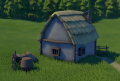
Older version of tier 1, density 1 house
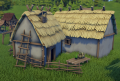
Older version of tier 1, density 2 house
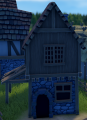
Older version of tier 2, density 1 house
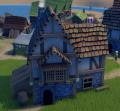
Older version of tier 2, density 2 house


